
Tabby was our best mole-catcher. She had the patience and the will. We will miss her.



Hold fast, run free – the blatherings of CBCalvin
Tabby was our best mole-catcher. She had the patience and the will. We will miss her.

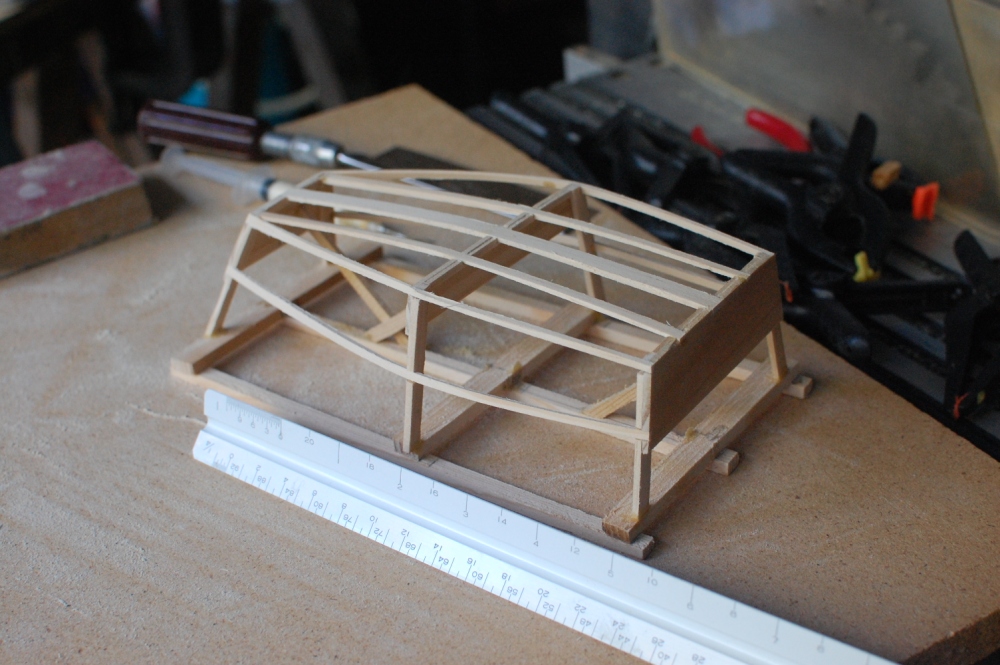 . Setting up the actual boat frames was complicated. If you were doing it full size, you could use a tape measure and level or plumb-bob. As it was getting the measurements set up in the middle-of-thin-air took some clever clamp-measure-move-reclamp action to get it just right over several days as I had to wait for the glue to dry to do the next frame. I think that the center bulkhead is 1/16″ off-square which would be 1/2″ in full size.
Once the frames were set up, the corners were notched and the chines and keels were set in. A little sanding to shape. 
The rudder and centerboard were next along with the mast, boom, and sprit. Finish is varnish.
The sail was laid out with a program named Sailcut. It neatly lays out panels perpendicular to the leech givin a very realistic appearance to the modeled sail. The “eyelets” are dots of gold sparkle-pen ink. 
Several years ago, I published a American Girl Doll: Leg Repair. I recently had the opportunity to do another repair and need to make a few revisions to my notes.
The dolls are now 17 years old. The doll in question is the oldest of the bunch. American Girl still provides a repair service and will re-attach arms and legs for a fee. They also return the doll with some “hospital visit” accessories such as a wrist band and a gown. There are doll hospitals in most large cities and individuals in smaller towns that provide doll repair. If you wish to attempt it yourself, here is one way to do it. Here is what I did this time.
Undress the doll. This will avoid soil and glue problems. When I examined the doll patient, I noted that the detached leg had a ball-joint that mated with a socket sewn into the cloth torso. An elastic cord is retained in the ball and holds the two parts together. The leg appears to be one piece with a hole molded in the hip-joint. There is what could be a mold-parting-line but I theorized that it was glued or sonicly welded at assembly time. I marked a small index mark on the inside of the thigh at the line with a Sharpie and carefully cut off the top of the leg with and X-acto knife. The socket in the torso does not require alignment. Just carefully cut the threads where the socket is stitched in. Inside the leg there was a plastic cup loose and a piece of elastic with an eyelet squished onto it as a retainer. In the stuffing in the torso, was a similar cup and piece of elastic. I believe that the cups are to make the elastic long enough so that it can be tensioned but still stretch far enough that the leg can be worked on. 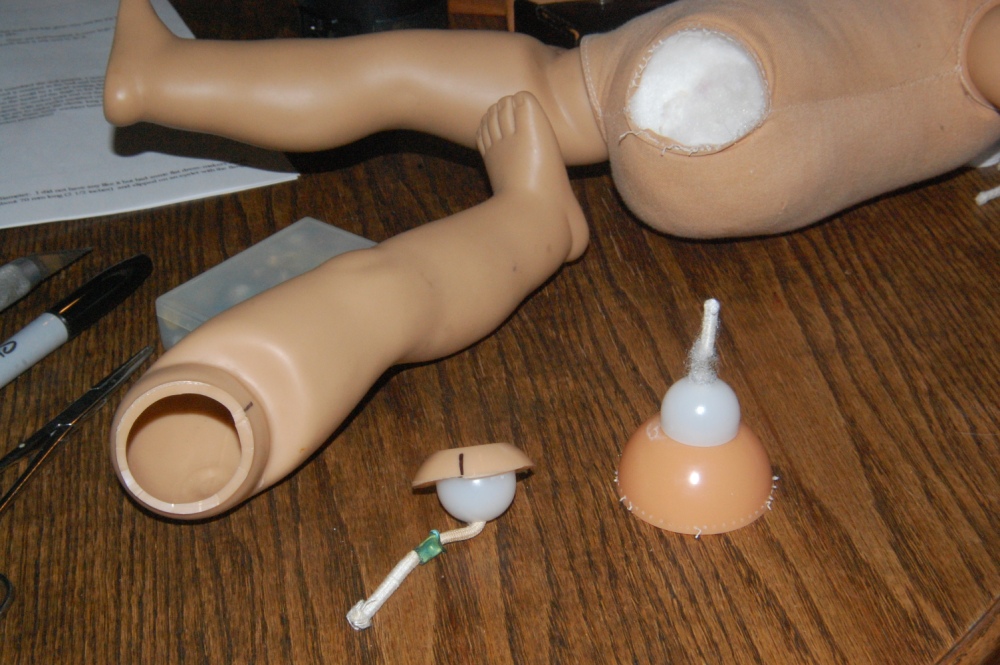
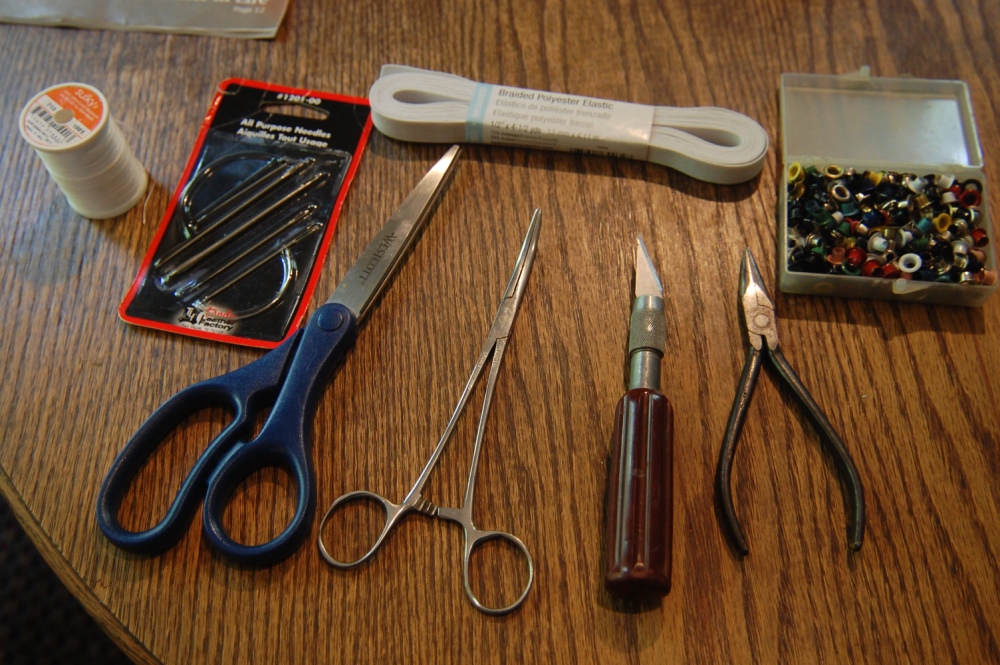
The original elastic is heavy-duty shock cord about 4mm (1/8 inch) diameter. I did not have any like it but had some flat dress-makers elastic about 13 mm (1/2 inch) wide. I used piece of elastic about 70 mm long (2 1/2 inches) and slipped on an eyelet with the flange away from the bitter end, drew it close and squashed the eyelet with a pliers to make a “knot”. I pushed the elastic through one of the cups so it came out the cup side. The cup should face the other way. The through the large hole in the severed leg-top. Next through the large hole in the socket, through the other cup and out the bottom. Last another eyelet is slipped on. Using another leg, estimate the tension required and pull the elastic up until the ball-to-socket tension is similar to a good joint. Mash the second eyelet to complete the assembly.
Place the socket in the torso with the alignment correct. Use hemostats or other small nosed clamps to hold the edge of the cloth aligned with the edge of the socket. The original socket was machine stitched but I used a glover’s needle and an overhand stitch to rejoin the socket and torso. A pair of pliers may be required to force the needle through the existing holes and draw it out the other side.
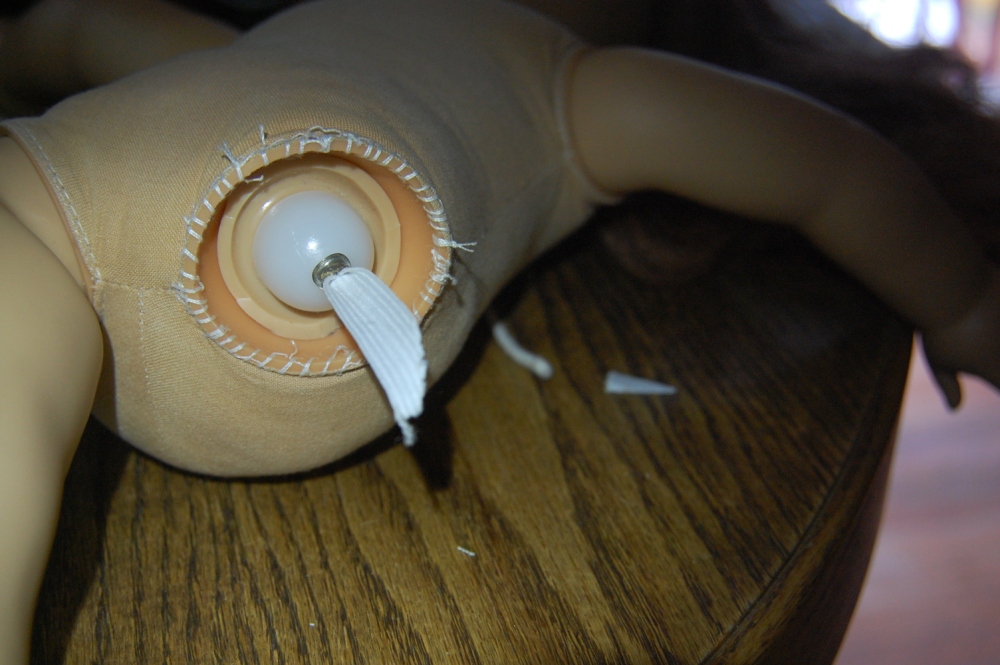
Separate the top of the leg from the socket with a hemostat, clothespin, or a pair of pliers. Put a small amount of gel type cyanoacrylate glue (CA or super glue) on the leg top where it was cut. Carefully replace the leg top matching the index you marked before cutting. Hold until set. The glue I was using remained sticky where it had squeezed out after assembly. A small amount of ammonia or a weak baking soda solution will cause this to set instantly.
<
Occasionally I forget to turn off my Nikon SLR. This is especially true when I have connected it to download some pictures. The USB connection keeps the screen alive and the EN-EL9 battery pack is dead in less than hour. Usually it will recharge. But sometimes it will not stimulate the charger and will not charge, no blinky lights, nothing.
As I understand it, Lithium Ion (Li-ion) batteries have a circuit inside that limits the charge current and keeps them from overheating during charging. When the battery is completely dead, this circuit has no power and it cannot allow current in to charge the battery.
I have been able to get around this by putting the battery in the charger, unplugging the charger, wait a 10-count and then plug it back in. Repeat until it appears the charge cycle is working (flashing light on my Nikon MH-23 charger). Monitor the charger for a few minutes. If the light comes on solid too soon, slip the battery out of the charger and back in. Check for normal charging activity. I hope this saves you from buying a new battery.
Whoa. I might get elected. I may have to (through my negotiating Secretary of State) have to get other negotiators who wish that God would remove this honest (and, full disclosure, dishonest) Nation from their list of challenges.
Given that the President proposes and the Congress disposes…
Proposed Presidential Platform Planks
Department of Homeland Security – rename and re-purpose
Change the name – Wet Blanket comes to mind
Department of State Security is already used (SS is right out)
Perhaps a popular contest with a big prize would yield something that works for the public and has less of a National Socialist flavor.
FBI – ok
TSA
No airport personnel (or train or bus stations for that matter)
New purpose – communicate important information/training/skills to local enforcement and transportation providers.
Airlines/Train lines/Bus lines are responsible for safe passage (or not).
Welfare
Everybody works. Show me a selfie of you fixing a broken window, picking up trash, helping a neighbor, calling voters/protesters, doing what you can, etc. Here’s your check. Each day, each week. Paid monthly.
Taxes
No more corporate taxes. Companies pay fees for services required/provided. Individuals pay taxes. Companies collect taxes and pass them through to the government.
Simplify taxes. One rate. One basis
If you receive it, it is income
Example – You are a CEO – your company decides that for the company’s protection you will fly in the corporate jet wherever you go.
The difference in cost between “regular airfare” and cost-of-corporate-jet is part of your income. You pay taxes on it. Or you can hire the pilot and pay his salary and deduct his/her W2 from yours (see below). (Don’t forget the SS etc.) But not the cost of the airplane.
Your company provides you with a car – cost is income to you regardless unless you can prove you NEVER use for any personal activity. Period.
Your company provides you with a meal as a convenience to them – cost is income to you. Period.
If you pay it to someone else as wage or a contribution to an approved organization you can deduct it.
Make sure you do a W2 on the former and document the latter.
Other than income and outgo, taxes are much simpler.
Other than the above, there are no deductions. You get it – income. You pay some body else – expense.
Individual businesses, partnerships, etc
Careful separation of personal ownership, asset distribution, gain/loss on purchase/sale will be required.
Your home is an investment. Gain or loss – yes, pay or deduct.
Your investments – Gain or loss – pay taxes when realized or when recognized or as accrued. Your choice. Annual documentation required.
Minimum wage
A company/organization/individual offers and pays any wage any time, subject to change with 6 pay periods notice.
If a company or individual has provided employment, premiums to an unemployment insurance fund are due.
Benefits
Any benefit paid to any employee is due to all employees, proportional to full-time hours however that is defined for the company.
This must be the “store open” hours or “available hours” if the employee is subject to flexible scheduling within some range even if the employee is not on the clock and actually being paid for work.
Health care
Folks who decline required vaccinations for their children decline compensation for all related health problems for themselves and their children. Children who elect to reverse (stand in front of a judge) their parents decision will be compensated going forward from the moment of rescission. For parents, the decision is irrevocable.
Foreign workers
Companies utilizing foreign technical workers must show that they have
1) Created and cannot fill a training program for U.S. candidates.
2) Ensure that each foreign worker, in addition to whatever technical work they do, mentor a replacement U.S. worker.
3) “Need them now” is not an excuse. Company poor planning should not come at taxpayer or workforce expense.
Someplace on your tax form, there is a check box allowing you to designate $3 to the Presidential campaign fund. Several government untruths here.
1. They are not “your” taxes. Taxes, by definition and numerous legal decisions, are already the governments.
2. Since they are not yours, they are also “mine” and “everybody else’s”.
3. The checkbox accompanying explanatory text says that it does not increase your taxes. This is strictly NOT true. It increases your taxes by $3/(divided-by)all-of-the-rest-of-the-taxes-wasted-by-the-overpaid-Senators-and-congressfolk. Admittedly a small number. But because you checked the box, I paid the same amount.
3. These funds will go to Presidential candidates. Yes, sort of.
Let me explain, wait a moment?
Can anyone explain why the stats at the FEC only are up to date as of 2013?
Where is YOUR money (if you were stupid enough to check the box). More important, where is MY money.
Let it be official. I shook hands with a constituent and said “I’m Chris Calvin and I am running for President”. Full disclosure, before this evening, my only politically related handshake was at the Riverside Station of the Boston MBTA Green line where I shook hands with Scott Harshbarger. Had I been able to avoid it, I would have and, in retrospect, I wish that I had.
The constituent commented that I had an honest handshake (implying “You are wasting your time”) and suggested that a “joy buzzer” might assist my campaign.
Open to consideration of all contributions, I replied “I need to be ‘always on’, solar powered with battery storage needs investigation. Thank you for the suggestion.” Wind-up is reliable but we need to be looking at productivity and cost reduction. Maybe we can put treadmills on the borders. If you run fast enough, you are in. If you are not in yet, you just are trying but not hard enough, “Thanks for the Energy”
Cleaning out my traveling bag, I found a clipping from Redmond Magazine, the Independent Voice of the Microsoft Community. The Editor, Jeffrey Schwartz comments in the November issue on large companies breaking up. This reminds me of a song that goes through my head from time to time (i.e. a couple of times per week). If you are an older person and have never heard it, I hope that you have saved heavily in non-debt, non-equity investments. A change is coming. If you are a younger person, keep going. You will prevail.
The fact of the matter is that too big to fail is too damn big. The anti-trust laws and the regulators are supposed to prevent this from happening. This is just additional evidence that the present and recent administrations are incompetent and, perhaps, corrupt.
But I digress. While Mr. Schartz’s astute editorial mentions HP, Symantec, and and Microsoft, IBM, and many large banks are also in this category. Please stand by. Adjust your set if you think it will help.
A comment and link near the end of Relist Watch on at SCOTUS blog reminded me of a time when I passed the candy “tray” to an airliner full of strangers.
My mother had been been born and grown up on the west coast of Florida. As my grandparents aged, she would vist them. The train would have taken too long so she flew. On one occasion, she took my older brother and me. It was a late night flight, leaving from Cleveland after supper and going to Tampa with a stop in Charlotte. The equipment was probably a DC-6 although I know that I also flew that trip on a Constellation. My mom was a good mom. She knew that small boys needed something to play with and something to read so we had books and a small case full of small toys, think “Matchbox” or “Hot Wheels” although I suspect they were way older since there were Zephyr style locomotives and airplanes from the 1930’s and cars and trucks to match.
Airliners were not pressurized then as today. Or if they were, the control was not as refined as many passengers suffered ear discomfort as the plane descended for landing. To help, the airline typically distributed chewing gum or hard candy as the airplane was about to begin descent for approach.
At that time, most airline cabin attendants were men. Then as now, they were there for safety (first) and secondarily, the comfort of the passengers. But the stewards must have been impressed with well-behaved boys about 5 or 6. They let my older brother and I pass out little rolls of 4 peppermint LifeSavers in silver foil and Navy blue paper wrappers, directly from the boxes they were packed in.
Yes it is true. You should never serve food (or eat food) directly from the package that it comes in. But if someone serves you, accept the service graciously. That is what my mom taught me.
