Mouse-wheel fix

22:13 29 May, 2011

The mouse wheel on the mouse that came with the Dell 8100 stopped working. Or at least is worked intermittently. If you moved your finger v-e-r-y slowly, you could get scroll to move. But the detent was too stiff for rapid moves. And of course applying more pressure clicked the middle button. I decided that there was slippage and determined to find out why.

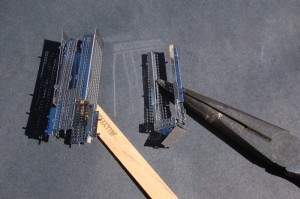
Picture of a disassembled computer mouse.

Figure 1

Disassembling a mouse is typically one-screw removal. On the Dell mouse, it in the center of the bottom approximately in line with the screw in Figure 1. After removing the screw, separate the shell halves. On this Dell this seemed a bit tricky. There are two tabs on the front of the top shell that insert into pockets in the bottom shell. These pockets can be seen in the nearest part of figure 1. A certain amount of force is require to overcome the springiness and friction. When you separate the top from the bottom, the mouse wheel will probably come loose as it is retained on the top by posts on the top half-shell. It rests in half-journals on the bottom. The skinny end inserts into the detent/switch component on the circuit board. The fat end is over the micro-switch (black component with white bar) which is farther away on the left. The other two micro-switches are for the right and left buttons.
The tire has been rolled off of the hub in Figure 1. What I found was that there was an oily substance between the hub and the tire. I used a piece of tissue, water with a touch of detergent (actually still in the sink from the lunch dishes) to clean the hub and the inside of the tire.
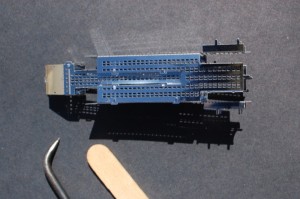
A picture of the wheel assembly re-inserted into its bearings.

Figure 2

Re-assemble the tire to the hub. Insert the small end of the shaft into the detent/switch as you set the wheel assembly into its bearings. Press the wheel down to verify micro-switch click. Rotate the wheel an verify that the detent works as it turns. Carefully insert the two tabs on the front of the top half-shell into the two pockets that can be seen out-of-focus in Figure 2 beyond the wheel. There is a critical angle and pressure that bends everything just enough. Once the tabs are inserted, lower the top half-shell until it is closed. Re-insert the screw. When re-installing a screw, it is a good idea to rotate in the removal direction (counter-clockwise) until you feel the click of the threads. Then proceed to tighten. This is especially true of self-tapping screws as it is desirable to re-use the original thread, not cut a new one.
Plug the mouse into a computer and test its function.
While I did not disassemble another mouse, a Dynex, I noted that the screw is not visible. If you do not see a screw, probe or remove any label on the bottom to locate a screw. Another possibility is a snap-together arrangement. I suspect the insides will be similar to the pictures of the Dell mouse.

Lawnmower Starter Rope Replacement

14:25 19 May, 2011
Screws to be removed from top cover

Figure 1

The other week when I pulled the rope on the mower, the rope broke off. Fortunately, the mower started and I just had the rest of the back yard to do. I finished it up, waited for the mower to cool and started the repair job.

Picture of pull starter cover with location of fueltank screws

Figure 2

My mower is a Yard Machines by MTD 22-inch side-discharge high-wheeler that I bought 15 years ago.

I have replaced the rope at least a couple of times. Here is how I do it.

For safety, disconnect the sparkplug wire from the sparkplug by pulling on the rubber cover.

There are two screws that retain the top cover. The screwdriver is pointing to one of them, the other is on located on the nearer side. Remove the screws with a Phillips screwdriver. Remove the top cover noting the index tab at the rear that engages the fuel tank. Also note the slot where cover allows the pull rope to pass through.

Location of lower fuel tank screw

Figure 3

Using a 5/16″ socket, break the 3 hex bolts on the top of fuel tank ring loose (Figure 2). Using a 5/8″ socket, remove the bolt located under the fuel tank (Figure 3). Catch the spacer that is located between the engine block and the tab on the fuel tank. Remove the 3 screws on top. Lift and tilt the fuel tank toward the rear of the mower. It will remain attached by the fuel line.

Location of 2 bolts at the front of the engine

Figure 4

The metal engine shroud is now exposed. Brush any dirt away from the lower end of the oil filler pipe where it enters the engine block. The oil filler will be loosened but not removed. But if it does fall out, cleaning will prevent dirt from falling into the crankcase.

Location of shroud screws at the back of engine.

Figure 5

There are two bolts on the front of the engine (Figure 4) and two bolts (Figure 5) on the back of the engine and the bolt that holds the oil filler. Using a 3/8″ socket, break loose the two front bolts and the two rear bolts. Use a 5/16″ socket to remove the bolt on the oil filler neck. Gently lift the oil filler neck to disengage the peg that holds the oil filler neck to the shroud. Twist oil filler neck slightly to get it out of the way.

Using the 3/8″ socket, remove the 2 screws each at the front and rear. Now lift straight up to remove the shroud and pull-start assemble. The starter will come out of the cup that is on top of the flywheel which engages the ratchet of the pull starter.

Pointed melted portion of nylon starter rope

Figure 6

Looking at the underside of the shroud, you can see the pulley that the starter rope needs to run around.  A tube inside the rim of the pulley (at approximately 9 o’clock position Figure 7)  is where the starter rope needs to be attached.  There is a small peg located opposite that will assist in winding the starter rope take-up spring.

Make sure the starter rope end is ready.  Measure the new rope against the old and cut to length.  Use a figure-8 knot to hold the rope in the handle.  A new rope will have the nylon melted and may be ready to go.  The melted portion should be no larger than the rope diameter (Figure 6).  If it too large or you have trouble inserting it in the next step, heat the end of the rope with a flame or soldering iron.  Use two pieces of wood to roll it into a pointed shape.  Be Careful: Hot nylon can give you a nasty burn.

Underside of starter pulley

Figure 7

Rope through tube on pulley and shroud

Figure 8

As you wind the pulley in a counter-clockwise direction, not that as you begin to feel tension on the spring, the ratchet levers are pushed out of the center area.  These will engage the ridges in the cup that is on top of the flywheel.  Continue winding the pulley 3 turns stopping when the tube is lined up with the hole in the shroud where the starter rope comes through. Push the pointed end of rope through the shroud and through the tube (Figure 8).  Tie a figure-8 knot in the end.  Slowly feed the rope into pulley as it unwinds.  When the spring is relaxed, there should be slightly less rope exposed than it takes to reach the location on the mower handle.  This slight bit of tension keeps the handle from drooping.  If the rope is too long, stretch it out, re-tensioning the spring, draw in a few inches and tie a new knot.

Lower the shroud over the flywheel.  Align the bolt holes, insert and finger tighten  1 bolt front and 1 bolt back.  Verify the operation of starter ratchet.  Release the blade-brake and pull the engine. Verify that the starter rope rewinds.  Insert and finger tighten the remaining bolts on the block.  Carefully, so that it does not pull out, position the peg of the oil-filler neck back in the hole in the shroud.  Insert the bold and tighten.  Tighten the 4 bolts front and rear.

Location ot the spacer

Figure 9

Pass the handle and rope through the mounting ring of the fuel tank. Reposition the fuel tank on top of the shroud.  Insert and finger tighten the 3 bolts on the ring.  Under the fuel tank, insert the long, shouldered bolt through the tab on the fuel tank, then through the spacer (located above the end of the finger in Figure 9) , and finally into the engine block.  Verify the adjustment and tighten all bolts.

Loosen the starter-rope guide on the handle to slip the rope into it.  There should be a slight tension.  Just enough to hold the handle in place.  If the rope is too short, it will put tension on the spring and wear the ratchet.  If too long, the handle will droop and snag shrubbery as you mow.  Verify operation by pulling the engine with the blade brake off and allowing the starter rope to re-wind.   If any of these checks are out, redo the steps above to make the appropriate adjustments. Reconnect the spark plug. Mower is ready to use again.

Sukiyaki

17:04 15 May, 2011
The finished sukiyaki on a china plate

The finished product.

Quite a few years ago, my late mother got a Sunbeam Electric Frying Pan. For some reason, I was at home from school (snowday? holiday?) and watching the “Today” show. A lady who may have been Estelle Parsons or perhaps Lee Meriweather presented a recipe for Sukiyaki. I saw a chance for my mother to use her new fry pan. I took notes. I noted especially that the the last ingredient was fresh spinach. “Mom can you make this”? She did. This is what I remember from the recipe. You can compare.
Carrots, red-bell pepper, celery on a wooden cutting board

Some of the ingredients


This is the recipe I recall, demo’ed by the Today show hostess. Set the fry pan to medium, a bit of vegetable oil, brown thin-sliced strips of beef. Set aside. Increase heat, brown carrot strips, celery, bamboo shoots (optional). Reset to medium. Add fresh spinach. Cover wait 3-4 minutes for spinach to cook. Serve with rice. Soy sauce.
Recently there was some left over steak strips and some bell peppers. The other night I made a sukiyaki-like dish as above, but no bamboo shoots using a conventional skillet over a gas stove. Pretty tasty. Should have used the whole bag of spinach though.
Vegetables stir fried in a cast iron skillet
Since the steak was already grilled, it just needed to be heated after the vegetables were cooked.

The grilled steak is added to the cooked vegetables.

Meat and vegetables set aside, spinach added to hot pan

Spinach in the hot pan

A cover over the skillet while the spinach steams

Cover the spinach while it cooks.

Meat, vegetables, spinach stirred in cast iron skillet.

When the spinach is done, add the meat and vegtables back.

Oven Ignitor Replacement

23:04 5 May, 2011

The Amana oven ignitor failed. Of course you only notice that when you are about to use it. Fortunately it was something that just needed heated, not a cake or something that really needed “Bake” at “xx0″ for “whatever”. We just ran the “Broil” to get the oven and the food hot. But the ignitor for the bake part still needed replacing.
Get the oven model and serial number. On this stove, they are located on the left oven frame, inside the bottom drawer. Then obtain the ignitor. In Greenville, I go to G+E Appliance Parts(closed Saturday. Banks is open until noon on Saturday) but you can get parts on-line if you have time to wait.
The ignitor is fragile. Open the box carefully ensuring that as you unwrap the layers of corrugated board that the new ignitor is always on the bottom. When it is visible, handle it carefully by the ceramic part only. Never touch the heat bar part.
Unplug or disconnect the stove or turn off the breaker. Verify that that the oven light goes out. Remove the oven wire shelves. Remove the bottom burner cover by lifting and sliding forward to release the tabs at the rear.

Remove scew at burner

Remove screw at burner.

You will see the guard over the ignitor at the rear of the oven next to the burner tube. Remove 1 screw at the burner and 2 screws

Remove 2 screws at rear

Remove 2 screws at the rear of the oven

against the back of the oven floor. Your oven may be different. The sheet that comes with the ignitor shows some variations. Pull the guard toward the front of the oven. The ignitor will come with it. Continue to pull carefully drawing the wires out until the wire-nut connectors appear. Unscrew the wire-nuts and disconnect the ignitor.

Withdraw guard, ignitor and wires

With the guard and ignitor out of the oven remove the guard from the old ignitor and slide it on the new ignitor until it hits the stop. Re-attach the stove wires with the wire-nuts. Stuff the wire and wire-nuts back into the hole, making sure that they go down the hole and outside the bottom of the oven. Re-position the guard and replace the 3 screws.
Re-connect the power. Test by turning the oven to Bake and an aribtrary temperature. The ignitor should glow white-hot within a few seconds. A bit later, the gas will come on and it should ignite. If this test fails, turn off the oven controls and investigate with the power off and gas off.
If the test is successful, replace the burner cover with tabs in the rear engaging the slots in the rear of the oven floor. Replace the wire racks.
I presume replacement of the boiler ignitor is similar. It gets used much less and I have not had to replace it.

Testing

MAF Sensor Replacement

23:59 17 April, 2011

MAF Sensor in the car

The Check Engine light on my wife’s 1999 Buick Regal 3.8L came on. After resetting it came on again in a day or so. It had been changed just about a year ago. It came on whenever it was moist outside. My first look at revealed that the cover was lifted. Perhaps moisture was getting in through lifted cover. I put some Goop on it and hoped that it would settle down.
After a couple of days, the light was on again. Time for a replacement. My son did some Internet research and found that someone who had re-replaced the rebuilt unit with a “new” unit and had good results. I got the new OEM part.
Installation of the MAF is straightforward. The only hitch is as a high value part, it has security Torx screws so you are going to need that special driver.

Disconnect the battery. Carefully release the locks on the plug and pull the plug. There are water seals inside so it can be a bit stiff. Slow and steady. Then remove the screws in the corners. Remove the sensor by lifting straight out. Install the new unit. Start, then tighten the screws. Replace the plug. Reconnect the battery.

MAF Sensor business end

The Mass Air Flow (MAF) sensor tells the engine control computer how much air is flowing into the engine. The computer uses this along with other inputs to decide mixture and other controls.

Under the MAF sensor lid

Since I bought the new unit, there was no need to return the “core” as with a rebuilt part. So What Is In There? The second picture shows the part of the MAF sensor that is in the intake duct. The air goes through the hole and by that horizontal bit. That is actually a “hot wire” sensor. Heated by a current, its resistance varies by temperature. The more air that flows by the cooler the hot wire and so its resistance comes down. You can see that under the lid there is a fairly sophisticated circuit associated with this device.

Toy Airplane Repair

15:20 16 April, 2011

Repaired airplane wheel

Repaired toy airplane wheel.

My niece, her husband, and 3 boys were here. My wife got out the Playmobil and Lego’s for them. In putting them away, she noticed that the wheel has been off one of the Playmobil airplanes since our kids played with them. “Can you glue this back on?”.
A wad of Seal-All or Goop would have held it on, or perhaps a wad of epoxy. But is one those small areas with high shear and high bend potential where glue has real difficulty.
Instead, I decided to drill a dowel to make a bushing, drill the landing gear strut to hold a screw and assemble the wheel, bushing, self-tapping screw and washer. I filed the point of the screw where it came through.

Making America Smarter

22:17 10 April, 2011

Today, once again I recognized and opportunity to make myself a little smarter. And then I realized that there are those folks who would make the USA a dumber place. I am thinking of those who would make a single “Official Language” the only lingua franca. Fortunately, they have to spar with those greedy, money-grubbing corporations that insist on publishing the instruction sheets for their products in two, three, four and more languages. Me, cheapskate that I am, am not about to sign up for Rosseta Stone, Berlitz, or private lessons. I read the English instructions and then use the other instructions to increase my vocabulary in Spanish, French, occasionally German, or Italian. For example, did you know that “bain d’oiseaux” was French for “bird bath”. From there, the leap to “Bain de Soleil” is a short one, with a mid-air tumble to “Cirque du Soleil”. Do this enough and you might recognize that that “eaux” ending was a plural. So maybe multiple birds or multiple kinds of birds.

Lego and Playmobil have the richest offerings in the multi-lingual instruction. You can get important safety warnings in all of the above plus Greek, Danish, Swedish, Norwegian, and Finnish. IBM hardware offerings are even richer covering the Near Eastern and Far Eastern languages as well. Apparently, none of these products are marketed in the Vatican, the final bastion of Latin, much to my disappointment.

Around 1965, Tom Lehrer wrote in a song about a rocket scientist of the time:

You too may be a big hero
Once you’ve learned to count backwards to zero
“In German oder English I know how to count down
Und I’m learning Chinese,” says Wernher von Braun

[Copyright Tom Lehrer (talk about visionaries), Wernher Von Braun, from memory]

Perhaps I listened to the wrong music as a teenager.

So when someone suggests that we should settle on American English and only allow that, they may be just trying to take away one of your choices. And choice is freedom. Of course stupidity is a a choice. No current medical evidence shows that language instruction causes brain injury. Yet hundreds of school systems cut language programs to maintain the funding for football programs. Go figure.

Math Jokes

20:53 29 March, 2011

I found a good collection of math jokes.
For example:

Q: Why did the chicken cross the Mobius strip?

A: To get to the same side!

Middle

18:26 27 March, 2011

Who? What? When? Why? Where? How? Those were the questions I was taught to ask on every doubt. I had the good luck to attend the only college with a basketball court size map of the 48 states of USA. I haven’t been back for years but I understand that the space has been re-purposed. Lacking the balcony view of the curve of earth (Who needs that now with Google Earth). And lights that light up (if they were working) of the selected cities on the switch boxes. At least the Babson Globe has been restored.
I was addicted to maps long before that and still. The INTERNET can provide.
Now (when it may be vital to establish jurisdiction) I discover that my (unnamed) INTERNET provider not only mis-locates me but makes my locus a place which differs from the center determined by measurement.
Potwin, KS may be a rounding error.
Eureka, KS may be a closer center.
If you don’t know what a theodolite is please check your reply a couple of times.

Chair Repair

23:26 26 March, 2011

We have had the dining room furniture for about 28 years. I have put some of it back together. Originally from J.C.Penney, the furniture is nice wood but quickly put together. The biggest problem in getting it apart is that the spindles, back, rungs, and frames are held together with those corrugated wood fasteners. It is very difficult to get the chairs apart without some damage. Ideally, you can take a chair apart with a firm tap (with a hammer and a protective wood pad) to separate the glue joint. With the fasteners, careful wiggling and pulling is required in addition to the tap.
Working with the pictures in the Gallery, a back and side view of the chair. In the second row left, a screw has worked loose allowing the frame to flex. Normally, the frame would be rigidly held by he seat. On the right a spindle has come loose from the leg, allowing the other legs to flex and work their joints loose. In the third row, as the frame works, the pegs that are glued into the the leg loosen and work. The glue block that holds the frame tight, has broken loose and is retained only by the staples used in assemble. Third row, right, before dis-assembly, use masking tape and a marker to identify the left and right pieces and where they are in the chair and how they are oriented. The back pieces are labeled 1-Top, 2, 3, 4-Bottom, Left (relative to sitting in the chair), Right. The Legs, Left-Front, Right-Front, the frames are labeled Front-Left (with the label to the left), Frames – Rear-Left, Left-Rear (with the label to the rear), Right-Rear, Runs Rear-Left, Left-Rear, Right-Rear, Front-Left-Top, Front-Left-Bottom.
When the labeling is complete, use a stubby Phillips screwdriver to remove the screws that hold the seat to the frame. Remove the seat d set it aside, put the screws in a baggy. Then use tapping and pulling to disassemble the chair. If a joint is tight and firm, there is no need to separate it. But be diligent to get the loose ones apart. Clean the loose glue from surfaces, holes and spindles of the separated parts. I prefer “Chair-Loc”, a compound that swells the wood and tightens the joint rather than glue for re-assembly. For it to work properly, clean wood is best. On the other hand, excessive scraping or sanding will make the joint loose and require additional work to make it tight.
On re-assembly, plan ahead. Make sure that you understand what joints are going to go back together and how. With chairs, the legs move toward the center simultaneously during re-assembly. Put Chair-Loc in each of the open holes and on the spindles before insertion. Work quickly before the wood has a chance to expand. Assemble all 4 legs, the 4 back panels, 4 frame pieces, and 5 rungs and press together. Use bar clamps and tapping to bring them firmly together. Make a bowline knot and throw it over a leg and wrap the chair with rope. It takes about 30 feet (10 meters) to wrap. Use a taut-line hitch around the back fineal and tighten to hold firmly while the Chair-Loc works. See the Gallery bottom left. Drip some Chair-Loc in the joints that you did not separate as well. Glue the glue blocks and clamp. Gallery bottom right. Use a damp rag to remove any spillage.
After a couple of hour, remove the clamps and rope.